ERM is ExpoCloud®
What is ExpoCloud?
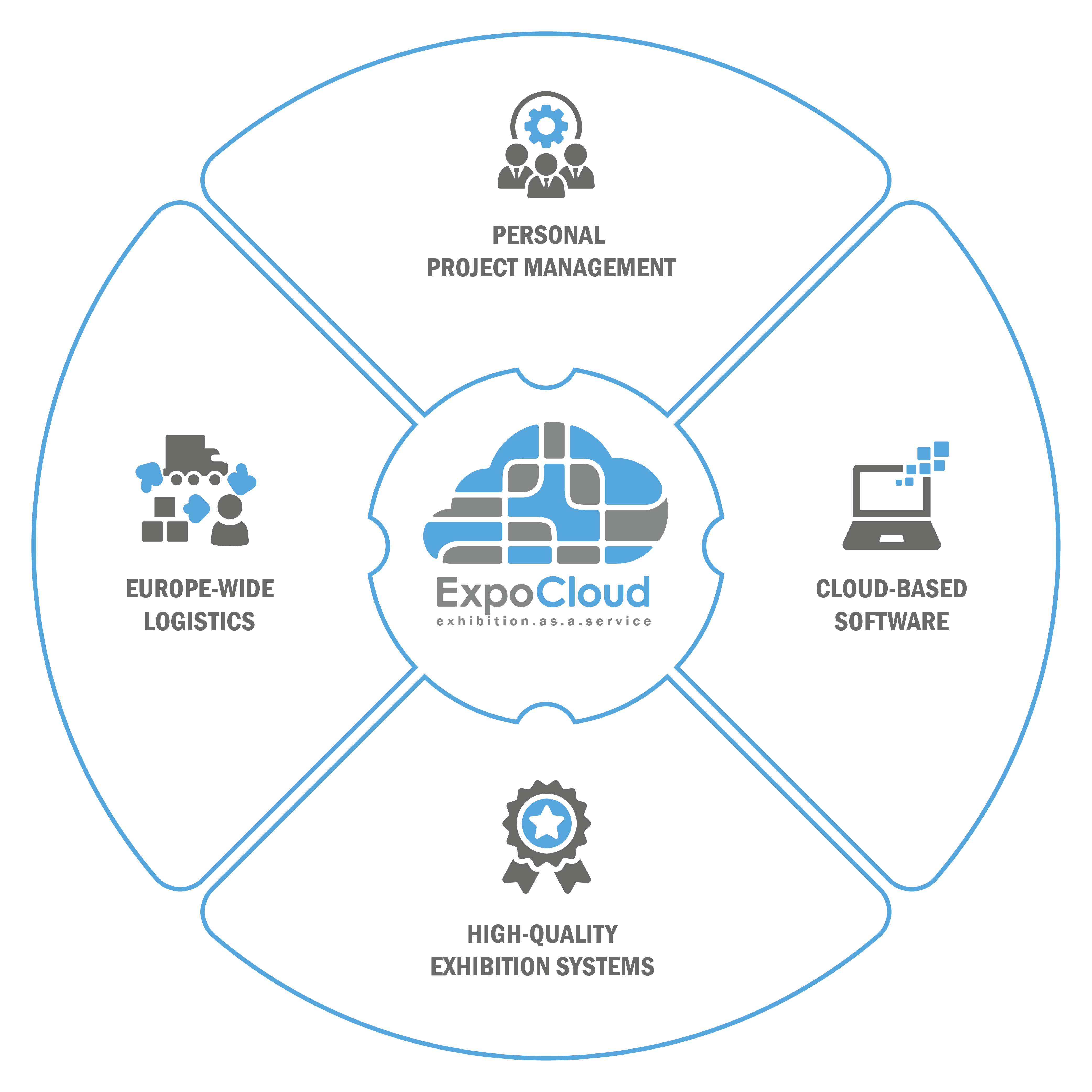
The ExpoCloud ecosystem is a brand of the WWM Group, a Europe-wide pioneer in the digitalization of event management, more precisely, event resource management (ERM). ExpoCloud represents its practical implementation. Event managers use a systemic approach that makes all event resources available via the web. You only need to define your trade show staff, everything else can be organized quickly, easily, and efficiently within a holistic system that integrates project management, web-based software, exhibition systems, and exhibition logistics.
Scientific Foundation. Logical Success.
The term “competence” is a cliché unless it is substantiated. Substantiation requires written language, because only knowledge and detailed expertise that can be reviewed and referenced are valid and sustainable. Mere lip service is the opposite of written language, without which, as is well known, no science in the world can function.
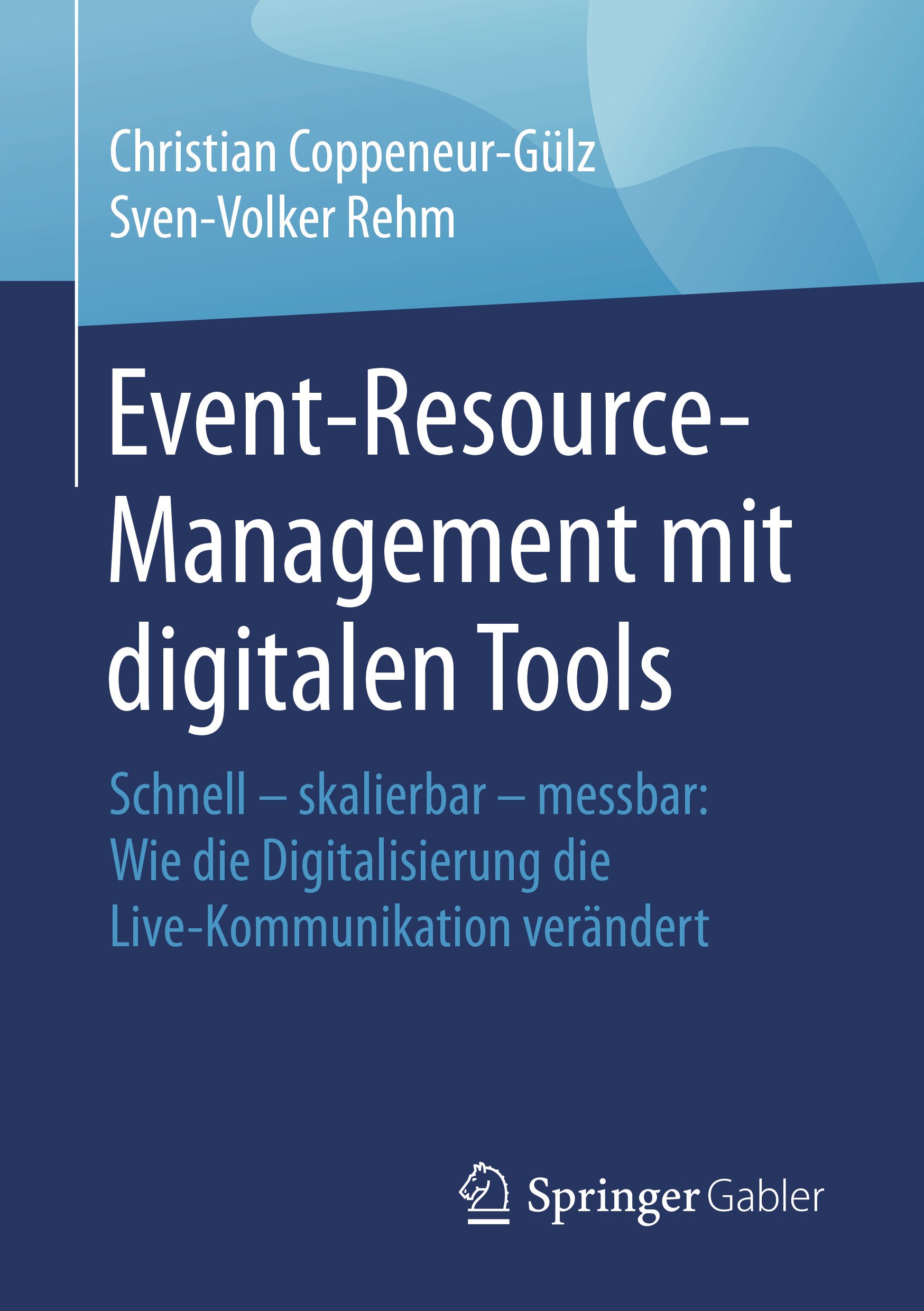
ExpoCloud is based on the groundbreaking ERM reference work “Event Resource Management with Digital Tools”, published in 2018 by the renowned academic publisher Springer Gabler. This scholarly book explains how event managers can use digitalization to accelerate, scale, and make their live communication measurable. Dr. Coppeneur-Gülz, Managing Director at the WWM Group, contributed to this publication as a co-author, bringing his expertise in exhibition management, business informatics, and business administration.
Holistic Coverage of Success Factors
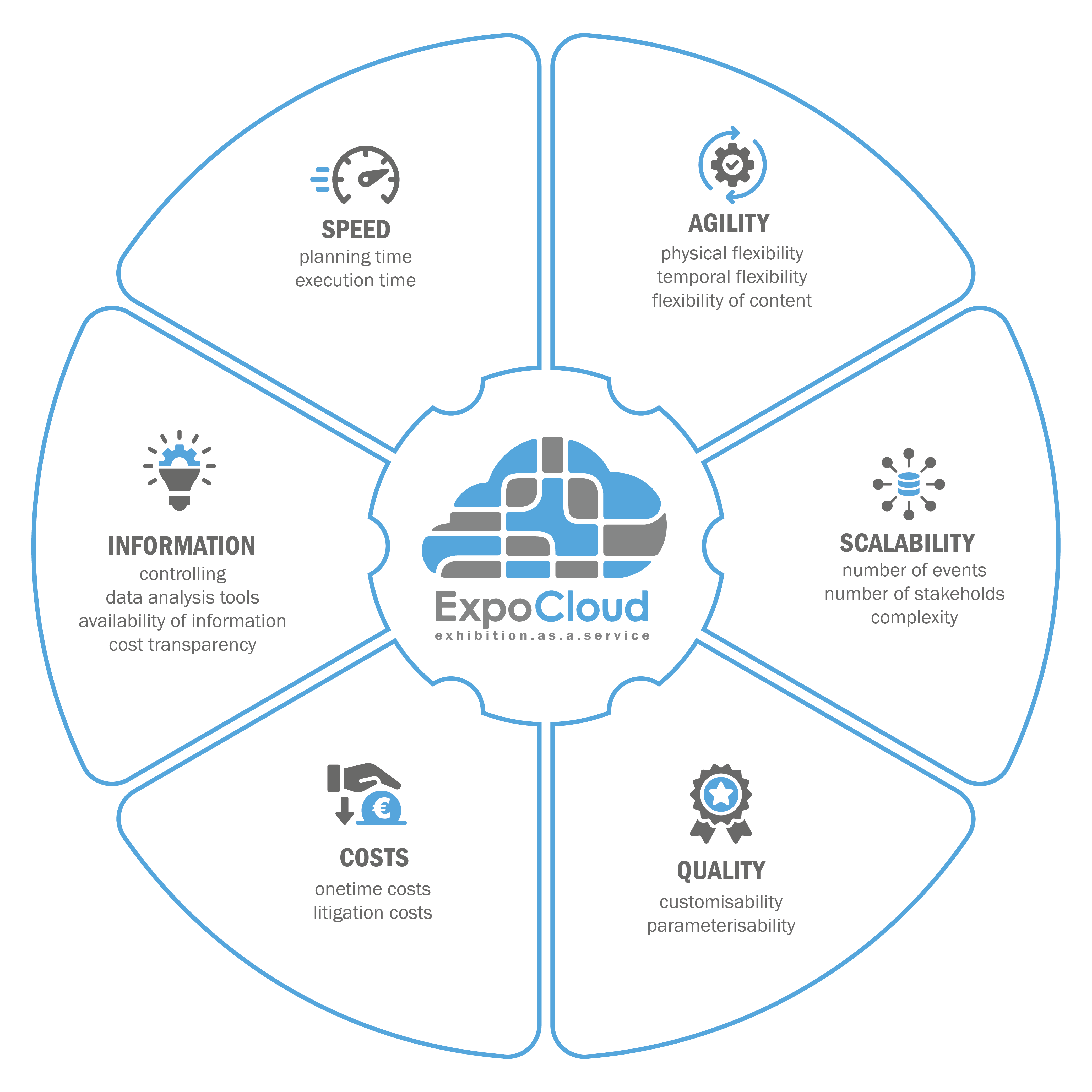
In the aforementioned reference work, the authors explain which specific factors are crucial for implementing highly efficient event resource management. These success factors, which contribute to the entire event lifecycle, are:
- Geschwindigkeit
- Agilität
- Skalierbarkeit
- Qualität
- Kosten
- Information
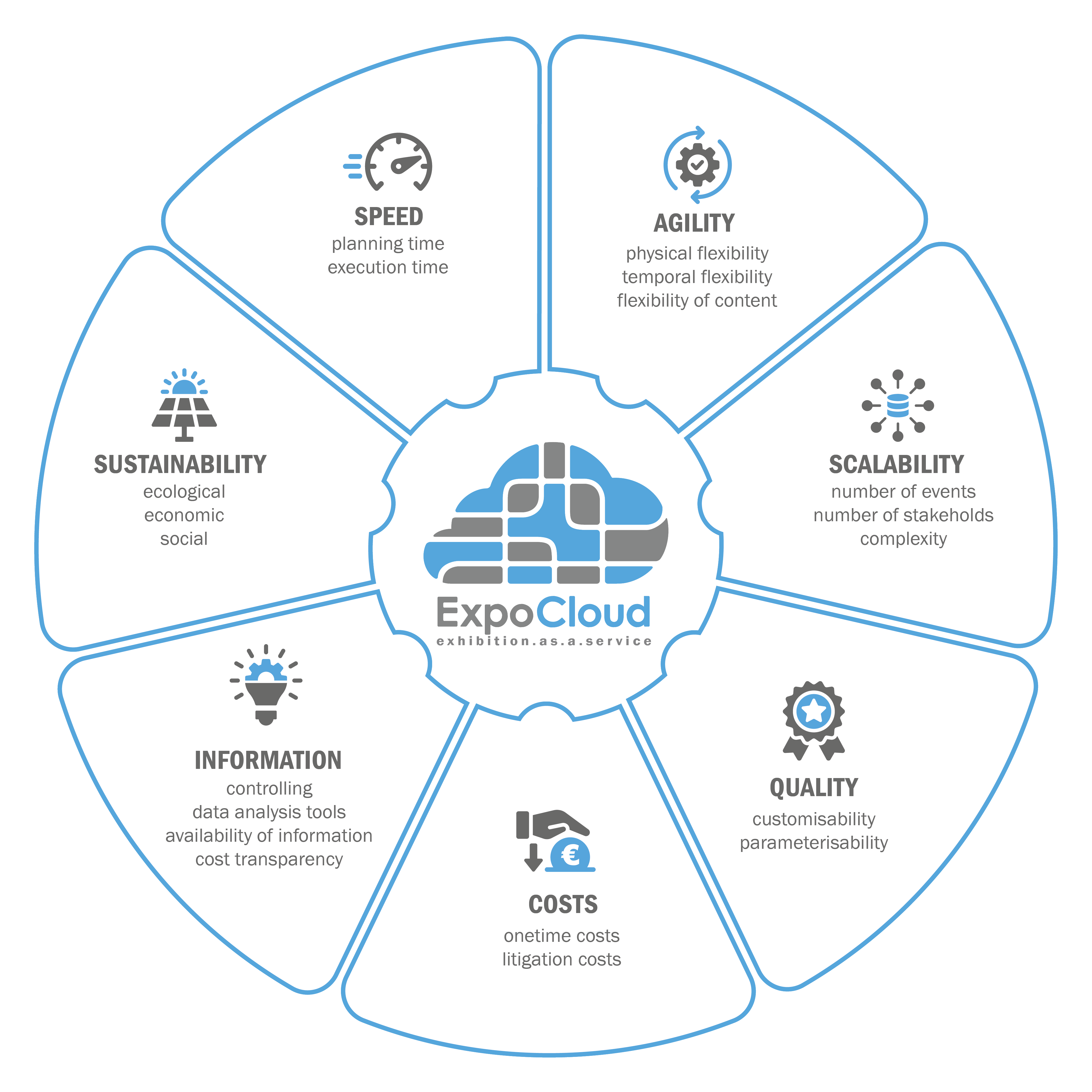
Today, ExpoCloud goes even beyond these six success factors, as the event industry must also address aspects of sustainability—sustainability that is inherently plural and encompasses both ecological and economic indicators.
Defining the New with the Blue Ocean Strategy
In the field of strategic management, numerous theories exist that are useful for market and product development, among other things. For the ExpoCloud ecosystem, the Blue Ocean Strategy (BOS) is particularly noteworthy, as it was successfully applied during product definition more than ten years ago. At its core, BOS emphasizes that sustainable success is achieved by creating new, innovative markets in which users receive both highly relevant and differentiated value. Such value is metaphorically described as “blue oceans,” highlighting the previously untouched nature of these markets.
Once a market is defined and developed according to BOS, an entirely new category emerges. With web-based event resource management, the umbrella brand WWM established such a category, more precisely, a previously unknown software category. The product brand ExpoCloud serves as the ecosystem for addressing this category. Event managers across all types of organizations benefit from numerous advantages that are highly relevant in everyday operations and clearly stand out from smaller, standalone software tools (differentiation).
The benefits you gain from ExpoCloud are multifaceted.
Four Aspects, Many Advantages
The Blue Ocean Strategy (BOS) requires answers to four essential guiding questions:
-
Elimination: Which factors need to be removed?
-
Reduction: What can be reduced drastically?
-
Increase: Which product elements need to be raised above the industry standard?
-
Creation: Which product components must be newly invented?
Applying these guiding questions to event resource management leads to insights that you can view in the following overview.
Elimination: Which factors need to be removed?
Explanation:
Customer value considerations can change (significantly), requiring the elimination of certain product components.
Application:
- Time-consuming consultations
- Labor-intensive coordination loops
- Clarification of material availability
- Singular planning of each exhibition stand
- Unclear planning processes
Reduction: What can be radically reduced?
Explanation:
Excessive differentiation unnecessarily drives up costs and complicates customer understanding. Reduction leads to cost reduction and simplicity (ease of understanding).
Application:
- Project-related production costs
- Selection of exhibition stand systems; only market leaders, no in-house builds, no niche providers
- Costs for project management
Enhancement: Which product elements need to be raised above the industry standard?
Explanation:
In the exhibition industry, small tools for order and inventory management are the norm. However, this is not enough, as customers require a holistic cloud-based software that not only handles orders and storage but also manages all steps in the event lifecycle.
Application:
- Holistic process support through web-based software
- Higher software reliability compared to manual processing
- More stable processes thanks to software-based execution
- Knowledge generation through the ability to measure exhibitions
- More valid information through software calculations
- More strategic insights through analysis capabilities
- Increased selection of rental equipment
- Integration of exhibition catering
- Scalability through increased speed and simplicity
Creation: Which product components need to be newly invented?
Explanation:
In the context of Event Resource Management, a comprehensive solution had to be found that covers all four phases of the event lifecycle (planning, execution, analysis, optimisation). In the WWM Group, this solution is called "Flywheel." ExpoCloud is the practical embodiment of this.
Application:
- A central platform for all four process phases
- Innovative analysis capabilities (Business Intelligence, Exhibition Control)
- Measuring visitor flows (Event-Metrics technology)
- Centralised collaboration of all event managers, who can view material availability in real-time.
Reducing Effort, Increasing Efficiency
Some event managers like to describe the ExpoCloud ecosystem as an “efficiency turbo”, a very fitting term, as efficiency in terms of time/process and cost/budget is the most important factor for objectively assessing the value of a system. ExpoCloud eliminates tasks that were previously labor-intensive and reduces event planning to a minimum. Standardization and digital automation enable significantly faster, more agile, and clearer planning, particularly for smaller and mid-sized events, such as recruiting fairs.
The elimination of complexity and unnecessary work steps goes hand in hand with a significant reduction in costs. With ExpoCloud, this is evident, for example, in the very low flat fee for project management. Competitors are forced to charge much higher project management fees because they lack standardization and digital automation. ExpoCloud, on the other hand, is based on processes that are refined down to the smallest detail, making a low flat fee possible. This allows you to invest your budget primarily in customized rental exhibition stands, not in administration and organization.
Expanding Possibilities, Creating Uniqueness
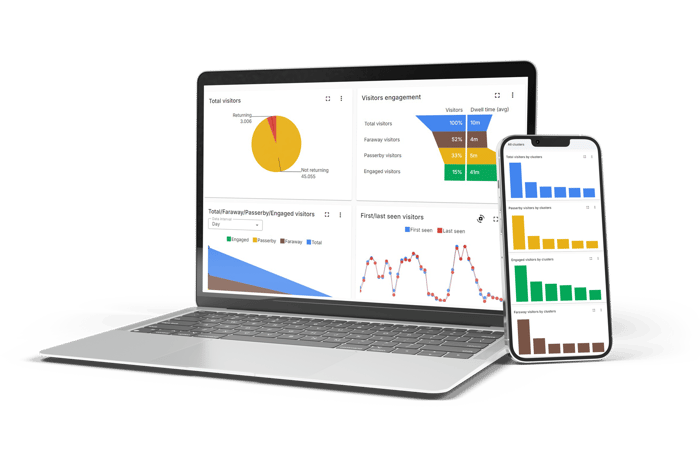
The web-based software of the ExpoCloud ecosystem is not only a guarantee for eliminating unnecessary work steps and reducing process costs, it is also an enabler that unlocks previously unforeseen potential. Digital modernization represents a quantum leap, especially when it comes to analyzing and optimizing your events: the integrated software module “Analytics” provides clear key metrics for business intelligence and reporting at all times, ensuring that your trade fair controlling is supported by valid data.
You can also book the exhibition technology “Event-Metrics,” developed in Germany, for your events, enabling you to measure visitor flows, fully compliant with GDPR, of course. Measurement technology becomes a source of insight, allowing you to analyze all events more precisely, comprehensively, and meaningfully.
An analytical capability that only ExpoCloud offers, the leading ecosystem for holistic event resource management.