Success Factors: Clear Benefits, Clear Future
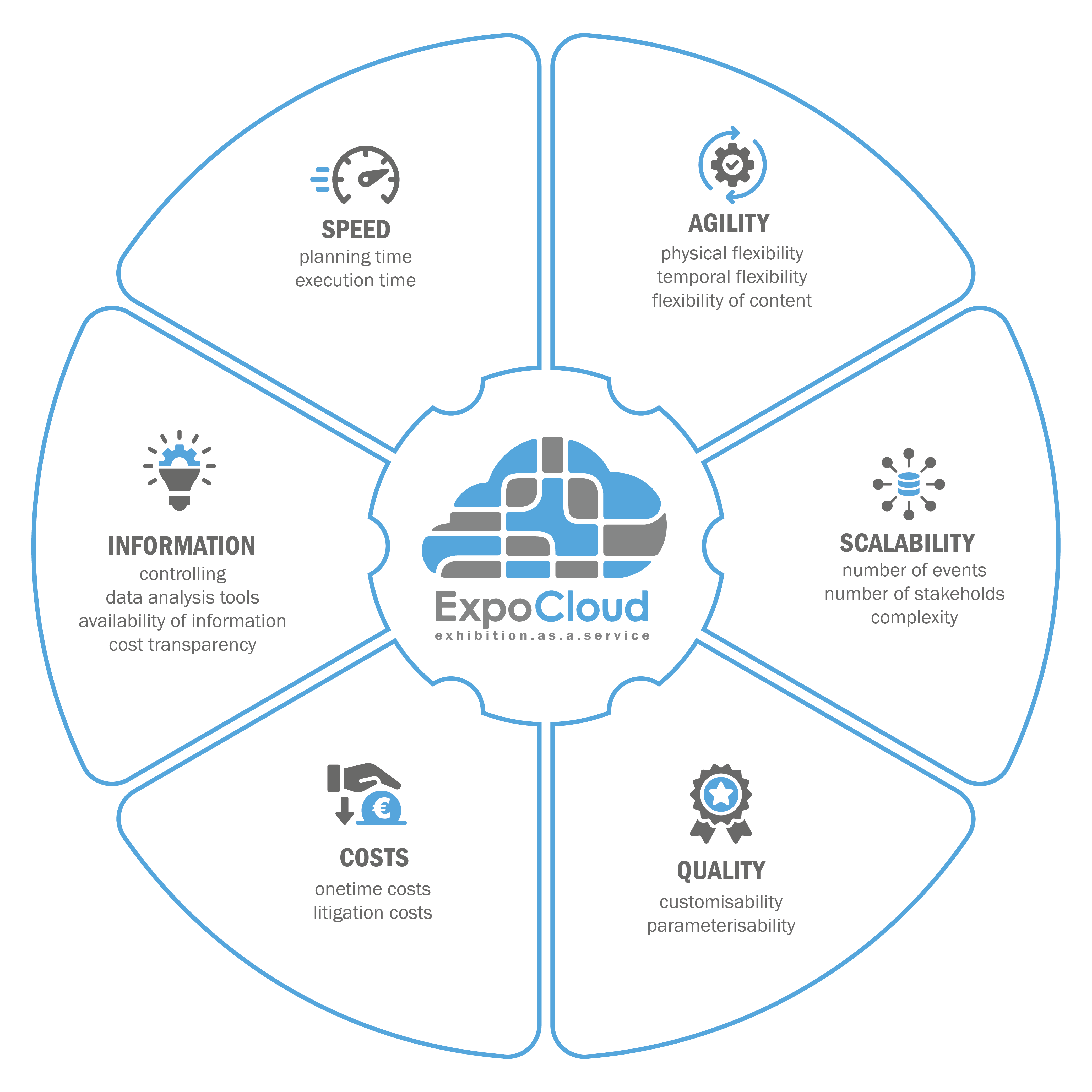
The six event success factors, speed, agility, scalability, quality, cost, and information, remain constant regardless of event size or industry, whether it’s a marketing-driven event, a recruiting fair, or a more sales-oriented occasion. The key question is how these individual success factors are expressed. With myWWM, you improve all of these success factors, grounded in scientific research and academically validated.
When you want to determine the specific characteristics of your event success factors, a before-and-after comparison is recommended. You measure the current status of your six success factors to establish your baseline. After implementing myWWM, you can reassess all factors and generate fact-based insights within your organization, valuable knowledge that benefits many departments, especially marketing, sales, and recruiting.
Sustainability as a Multifaceted Achievement
Naturally, sustainability is also a success factor, indeed a central one that is gaining increasing importance in the event and trade fair industry. In everyday use, the term “sustainability” is often simplified and associated mainly with aspects such as climate protection, resource conservation, and waste reduction. All of these are, of course, important, but sustainability goes far beyond ecological concerns. Everything that is lasting, future-oriented, durable, stable, and reliable can be considered sustainable.
Sustainability is the key concept when discussing corporate social responsibility, an overarching topic that takes a holistic view of nature, the economy, and people. This aligns with the myWWM ecosystem, which is also designed holistically: rental exhibition stands conserve natural resources (ecological sustainability), generate greater economic success (economic sustainability), and provide livelihoods for many people (social sustainability).
Anyone professionally involved in live communication, you and all ExpoCloud users, belongs to a shared community: a network whose social sustainability is closely linked to trade fairs and events that are planned, executed, analyzed, and optimized in an environmentally responsible and economically effective way.
Here are some sustainable ExpoCloud references